The green transition is accelerating structural change in the energy sector, but is also increasing mining and industrial investments, as well as investments in the electricity grid and telecommunications infrastructure. It has created a positive momentum for infrastructure construction, according to INFRA ry's regional economic reviews.
Infrastructure investments will continue on a two percent growth curve in 2026, despite the uncertainties in the operating environment. The energy transition will replace the market lost in the slump in housing construction.
“Wind power construction is in decline, but solar power plants, for example, are now being built throughout Finland, except for Lapland. This is accompanied by investments in electricity storage, and as a result of the energy transition, electricity transmission connections are also being strengthened. The snowball effect is creating jobs in the infrastructure sector throughout Finland,” INFRA CEO Paavo Syrjö rejoices.
"Municipalities are also investing in infrastructure despite their challenging economic situation. The six largest cities are increasing street and other infrastructure construction. In Helsinki, Vantaa, Tampere and perhaps soon in Turku, tram investments are growing the market and creating jobs."
Image: Market outlook for INFRA areas 2026 compared to the previous year.
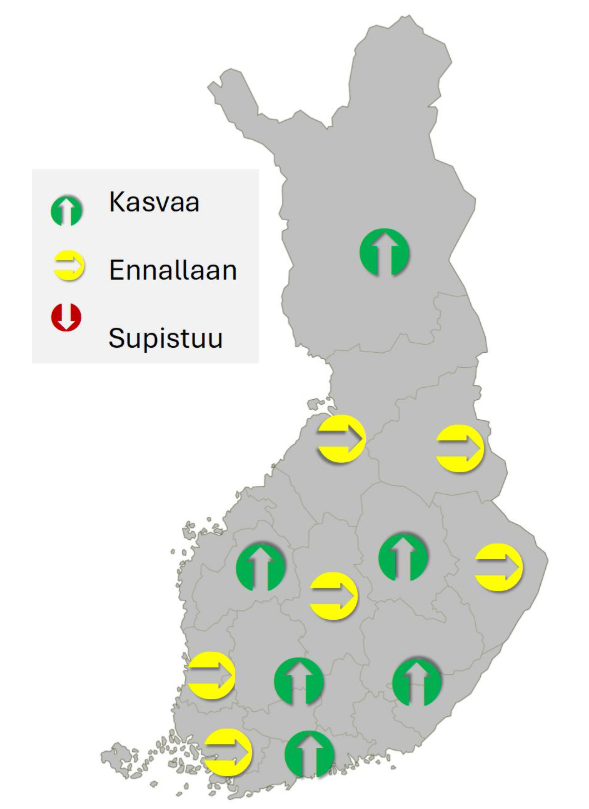
The most significant growth in the infrastructure market is concentrated in the areas of INFRA's Uusimaa, Häme and Ostrobothnia districts. The regional analysis also highlights mining investments in Ostrobothnia, Kainuu, Lapland and North Karelia, which, however, with the exception of Ostrobothnia, will only be realised in the 2030s. Data centres are being built especially in Uusimaa, South-East Finland, North Ostrobothnia and Kainuu. In South Savo, there are also two projects in the Mikkeli region at the permit stage, and construction is expected to begin as early as 2026. Industrial and public construction provide employment in several provinces.
Bus funding is targeted at the busiest connections
Based on INFRA's regional reviews, rail investments are concentrated in the Helsinki Metropolitan Area, Pirkanmaa, Kanta-Häme and Turku. The largest road investments are in Uusimaa, Western Finland, Häme, Central Finland and Northern Savo.
Small road and rail improvements and bridge repairs are still being carried out throughout Finland using the basic highway maintenance debt financing. There are also projects improving overall security and military mobility across the country.
"The focus of infrastructure investments is on areas where people move the most, such as the Vantaa tramway, the Helsinki–Tampere railway and the Espoo city railway, as well as the E18 in Raisio and the Vt 5 between Leppävirta and Kuopio. The over three billion euro infrastructure investment program of Prime Minister Orpo's government is now particularly employing contractors' tender estimators. Many projects will start this year, and that means work for the main and subcontractors building the infrastructure," Syrjö analyses.
INFRA, which represents the infrastructure sector in the Construction Industry Federation (RT), published its regional economic outlook at the Trade Fair in Tampere on March 11, 2026. INFRA's member companies build and maintain transport, municipal and energy infrastructure, produce construction aggregates, and offer demolition and recycling services and material logistics services for the mining industry.
Additional information:
– Paavo Syrjö, CEO, INFRA ry (rt.fi/henkilo/paavo-syrjo/)
– INFRA executive directors in the regions (rt.fi/toimalamme/infra/asiantijamme)
Regional business cycle reviews:
- INFRA Häme (Pirkanmaa, Kanta-Häme, Päijät-Häme)
- INFRA Southeast Finland (Kymenlaakso, South Karelia, South Savo)
- INFRA Central Finland
- INFRA Western Finland (Southwest Finland and Satakunta)
- INFRA Ostrobothnia (Ostrobothnia, South Ostrobothnia, Central Ostrobothnia)
- INFRA North (North Ostrobothnia, Kainuu, Lapland)
- INFRA Savo & INFRA North Karelia (North Savo, North Karelia)
- INFRA Uusimaa