Helsinki's Crown Bridges project is progressing half a year ahead of schedule and within budget. The bridge connecting Laajasalo, Korkeasaari and the city center was opened to light traffic in April.
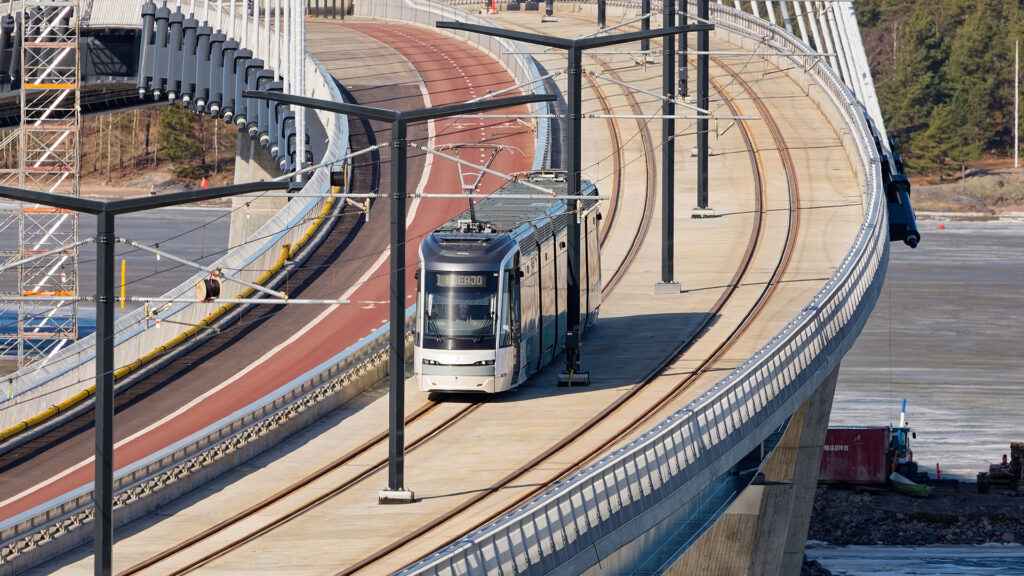
The most central part of the Kruunusillat project, the Kruunuvuorensilta, was opened for pedestrian and cycling use on April 18, 2026. The approximately 1,2 kilometer long bridge is the longest and highest in Finland.
Kruunuvuorensilta is part of the Kruunusillat tramway network, which also includes Merihaansilta, which connects Hakaniemi and Nihti, and Finkensilta, which leads from Nihti to Korkeasaari. All three bridges are now open to light traffic.
The alliance that built the bridges estimates that the completed tramway will be handed over to the customer as early as next summer. Originally, the construction work was not scheduled to be completed until the end of 2026. After the handover, the tram drivers will begin training on the new route.
The ten-kilometer tram and light rail connection from Laajasalo to the city center is planned to be fully operational in 2027.
An exceptionally demanding marine project
The Crown Bridges were an exceptionally demanding project in Finnish infrastructure construction, both technically and in terms of construction conditions.
The bridge connection was built in an open ocean landscape. The foundations were built on rock and partly below sea level. The construction site was exposed to wind, ice and variable weather conditions. The massive structures required special solutions, such as underwater concrete casting.
The bridge connection is almost 20 meters wide at its widest point and is designed for trams, pedestrians and cyclists. There are only a few bridges of this type in the world.
Collaboration plays a key role
Close cooperation between the various parties was a key factor in the implementation of the project. The client, designers and contractors worked together as an alliance, sharing risks and benefits.
The goal of the alliance model is to solve problems together and guide decision-making from the perspective of the overall benefit of the project. In practice, this has been reflected in, among other things, adherence to schedules and budgets.
Similar results have been achieved in several large Finnish infrastructure projects in recent years.
The effects are far-reaching.
The significance of the Kruunusillat project extends beyond the development of the transport system.
The bridge construction phase alone has directly and indirectly employed thousands of people, and the project generates tax revenue both during and after construction.
According to established calculation models, 20–25 percent of infrastructure investments are returned directly to the public finances in the form of taxes, and up to 30–40 percent in the form of taxes and fees. In the Kruunusillat project, this means at least tens and even over a hundred million euros will be returned to society. When completed, the connection will improve Helsinki's internal accessibility and support the development of new areas, which will again generate new tax revenues.
The project's effects have had a strong impact on the whole of Finland. For example, all the load-bearing steel structures of the bridges, such as the steel main girders and the steel-structured section of the impressive central pylon, came from Kalajoki, Nordec Oy. A significant supplier of concrete was the family-owned company Ruskon Betoni Oy, based in Oulu.
The partners of the Kruunusillat Alliance are the City of Helsinki, Kaupunkiliikenne Oy, YIT Infra Oy, NRC Group Finland Oy, Ramboll Finland Oy, Sweco Finland Oy and Sitowise Oy.
The contractors for the Kruunusillat overall project are YIT Infra Oy and Kreate Oy.
Also read the blog: The Crown Bridges project revealed the superpower of the infrastructure sector – and with its help, we could reach even Tallinn or Stockholm