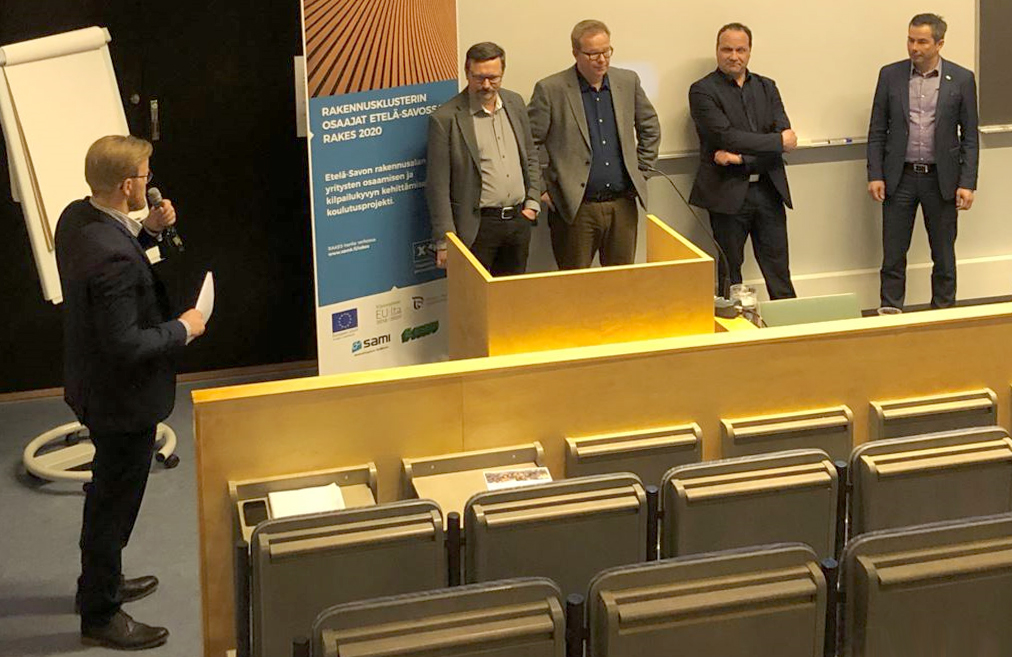
Xamki's Savonlinna campus was heard on 25.3. about the possibilities of hybrid construction and data models in reducing the carbon footprint of construction. The event was organized by the RAKES project of the Fiber Laboratory of South-East Finland University of Applied Sciences, which is supported by the ELY Center of Etelä-Savo and the European Union Social Fund.
The seminar was opened by the Ministry of the Environment Matti Kuittinen by reminding why low-carbon construction is also being invested in in Finland. Carbon dioxide emissions from human activities should be reduced by an average of 18% every year for 10 years, so that the Earth does not warm more than 1,5 degrees. About a third of greenhouse gas emissions come from construction and buildings. With very radical cost-saving measures, material-specific emissions can be reduced to a tolerable level, which would be about a third of the current situation. This requires a new kind of circular economy and life cycle thinking, which, according to Kuittinen, can be a great opportunity for Finns.
Construction can also have positive climate and environmental effects, i.e. the so-called handprint. Examples are e.g. long-term storage of carbon in a wooden frame, decarbonization of cement-based products and the use of recycled materials, reminds Kuittinen.
Concrete industry Jussi Mattila raised the starting point of sustainable construction as a balance between the environment, social factors and the economy, and considered the design of the useful life of buildings. 50% of basic buildings with a 50-year life expectancy are at the end of their life cycle after 5 years, and half after 150 years. An example of this is Hervanta, Finland's largest suburb in Tampere, whose oldest houses are approaching 50 years old, and demolition is not in sight.
According to Mattila, construction materials are used exceptionally evenly in Finland, even though the share of wood has decreased slightly due to the decrease in the construction of small houses. In the world, the situation is slightly different. "The volume of construction is huge. For example, in China, as much as the entire construction stock of Finland is built every month, and concrete construction is highlighted."
Promoting hybrid construction requires knowledge of the basic properties of the products. Mattila recommends avoiding materials that are difficult to recycle and keeping solutions simple. For example, embedding building technology in frame structures makes both repair and recycling of materials difficult.
Technology industry Kimmo Järvinen emphasized the flexibility of transformation and that no individual material is better than the other, but the intended use is what matters. There are many actors and materials in construction, and managing the whole is challenging. "Studies have found that traditions guide construction choices. Finland's strength is the balance in the use of building materials, and the challenge of urbanization is met with the help of all building materials," said Järvinen.
Wood info Mikko Viljakainen according to the current pace of global urbanization, one apartment will be built every second until 2050, and the threat is a shortage of workers. The production shortfall can be answered with industrial construction, which requires the combination of different materials. As examples, Viljakainen mentioned the advantages of concrete in mast stiffening and footfall sound insulation, steel power connections and the lightness of wood, as well as when seeking carbon neutrality.
Viljakainen also highlighted another type of hybrid construction, i.e. combining different functions in the same building. In the example, the lobby and meeting services would be at the bottom, the offices on top of them, the hotel in the middle and the apartments at the top.
"Instead of material and industry-oriented development, I would like designer-led development, in which case quality awareness and overall cost management could be achieved better. For example, high quality is produced in Austria at half the cost of Finland," Viljakainen said.
Emeritus Professor, University of Liverpool Arto Kiviniemi extensively shed light on the possibilities of information modeling mentioned by Matti Kuittisen. Information modeling has been developed for decades and Finland has been one of the pioneer countries. On the other hand, data models have still not been properly implemented in the management of the operational life cycle of buildings. "The problem is the focus on the construction process and we often don't yet know what information we want from the models," says Kiviniemi.
The connection between data modeling and sustainability is in simulation. Data model-based simulations should be developed so that all the different Model Levels of society are made to work together. The product supplier must be persuaded to standardize their products so that they can be used in simulation models. Kiviniemi also highlighted the optimization of early design solutions with simulations, which is a great opportunity to reduce the carbon footprint and life cycle costs.
Kiviniemi also raises critical questions. Are modeling and simulation tools used effectively and correctly, is the customer willing to make purchasing decisions other than based on price, and do the buildings function as they were designed.
"Environmental legislation must steer towards more sustainable choices, otherwise purchasing decisions will be made on the basis of price," Kiviniemi points out, and continues his criticism: "In the United States, it has also been observed that some environmentally certified buildings consume more energy than conventional buildings."
The day ended with a panel discussion between industry and education representatives. In the discussion, the common will and need to develop construction and the need to increase training and know-how emerged. The common view of all was that national legislation is needed and it must be prepared equally among all parties in order to achieve the best compromise. In order to take into account the positive environmental effects, the panelists also wanted the carbon footprint mentioned by Kuittinen to be included in the calculation models.
"We strive to develop industrial wood construction and sustainable low-carbon construction more generally as a new pillar of vitality for Xamk's operating area in Southeast Finland," says the research director Lasse Pulkkinen From Xamk. Xamk is a strong RDI player in sustainable construction in Southeastern Finland. For example, more than 2 million development measures related to wood construction are underway. worth of euro.
"The RAKES project will continue to organize trainings and seminars related to sustainable construction. Next up is 22.5. Carbon footprint modeling training in Savonlinna. Training calendar and already 25.3. You can find the presentations and the recording of the Hybrid construction seminar www.xamk.fi/rakes", says the RAKES project manager Anti Rohuma.
Kimmo Anttonen Regional Manager for Eastern Finland