The accident rate has been the main and basic indicator of occupational safety for a few decades. It also rises to a central role in safety discussions year after year. I think it is high time to find better indicators to replace it, or at least introduce other ways to monitor the operation and development of occupational safety in the construction industry.
Accident frequency measurement and perceptions of its effectiveness have a long history. Therefore, it is likely to continue to be seen as a valid metric regardless of the organization. However, it presents significant challenges in terms of comparability.
What are the biggest challenges in measuring accident frequency?
Many people may assume that the accident frequency rate is a globally comparable way to measure safety. However, this is not the case. One challenge is social insurance, as compensation systems differ from country to country, and in some places they do not exist at all. This is most typically seen in the fact that accidents that lead to shorter absences are not recorded with the same accuracy as in Finland. Our compensation system is structured so that the costs of an occupational accident are compensated from the very first visit and thus also recorded.
The collection of data in organizations itself poses its own challenges: whether to monitor the frequency for your own personnel or for all operations, including partners, which further adds uncertainty to the figures. There can also be a great temptation to manipulate the accident frequency if targets and performance bonuses are linked to it.
I think the real core flaw in accident frequency is that it only tells about the past. It doesn't share information about the work and activity that has been done in organizations regarding occupational safety.
However, I do not believe that accident frequency should be completely forgotten. It works well as a longer-term indicator that can be used to monitor the accident development of a selected organization.
Other options for measurement already exist
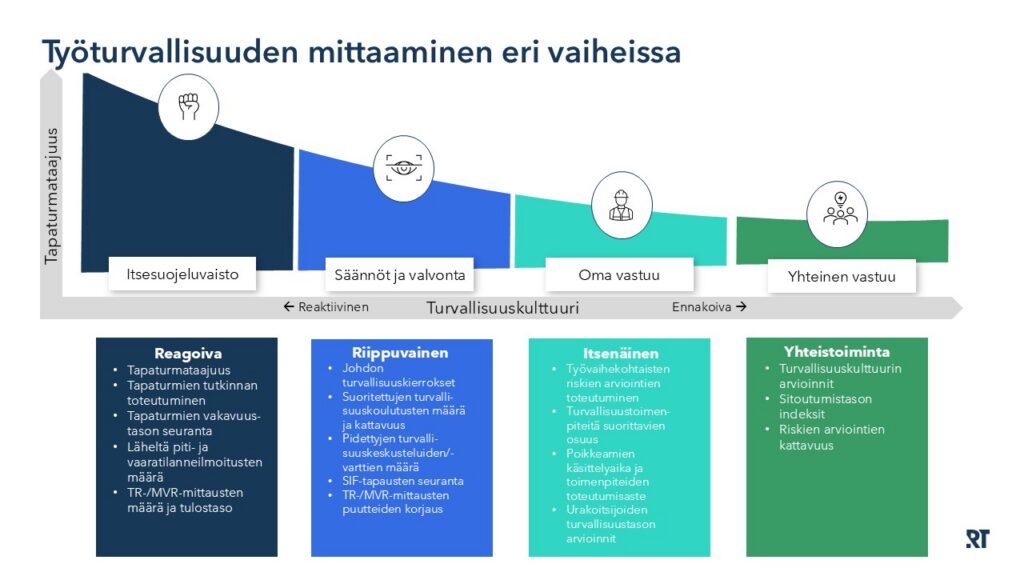
Fortunately, there are many different measurement methods available for measuring occupational safety. However, before implementing metrics, you need to think about measures that can be measured. Of course, that's how it should be: actions and measures determine the level of occupational safety and shape the safety culture in the organization.
An organization should always choose the most appropriate metrics from the perspective of developing its own operations. And to avoid the measured results showing only zeros, it is worth creating metrics for measures that are already being taken in the company. However, if a new measure or operating model is introduced, it is worth defining monitoring and metrics right from the start.
Safety observations are excellent and functional measurable things, which have long been part of everyday life in many companies. In addition to numerical data, it is possible to link observation practices and their measurement to, for example, how comprehensively personnel carry them out. The information provides insight into whether safety observations are only carried out in part of the organization, or whether it is a genuinely common practice across the company.
Management safety tours are still a new way of working for many construction organizations. Quantitative measurement of management safety rounds is of course easy, as long as management representatives are first regularly visited construction sites to discuss safety. In addition to quantitative data, it is possible to collect information on the number of discussions held right from the start, and qualitative data on the core topics of the discussions. These can include, for example, identifying the key hazards of one's own work and the correct procedures for avoiding them, using the protective equipment required for one's own work, or the safety climate at the construction site in question.
Look more strongly to the future, not the past
Safety is developed significantly more effectively through proactive work than by dealing with accidents afterwards. Of course, lessons must be learned from accidents that have occurred and necessary corrective actions must be taken, and sometimes things must be investigated in more depth. But primarily, occupational safety is improved by identifying, assessing and planning in advance how the work is done, its methods and conditions, and possible issues that may arise.
When this happens, it is time to measure these measures as well. The training provided, its coverage among personnel, the risk assessments carried out, the work safety plans drawn up and the last-minute risk assessments are hard evidence of the contribution made to occupational safety. However, this requires that these policies are implemented within the organization.
It is a good idea to introduce practices and metrics in stages and as they develop. Evaluating or measuring your own organization's practices or safety culture is not very fruitful until the above-mentioned measures, which reflect the actual culture, have been implemented and measured.
Why does RT collect accident data from its members and present accident frequency figures?
RT has been collecting accident frequency and variable data, as well as working hours, in various industries for quite some time now. And as stated above, accident frequency, let alone variable data related to accidents, should by no means be completely ignored or forgotten. They simply do not tell the whole truth about the state of safety.
RT has obtained comprehensive quantitative information on accidents occurring in its member field, and thus also in the entire industry. It is essential that the information is collected from a large number of people and that long-term monitoring can be carried out from it, and through this, interpretations of developments and possible underlying factors can be made.
In my opinion, more important than objective data is information about the variables, i.e. the factors behind accidents, and their descriptions. The information, filtered and edited, can be directly utilized in companies' and organizations' own proactive safety work, for example in risk assessments, when identifying factors that may cause accidents. Our member companies can access this information through the Reitti service and through safety reviews prepared based on information provided by companies.
How do you measure safety?
Participate in member training in January

Henri Litmanen
Specialist, occupational safety
henri.litmanen@rt.fi +358 50 576 5988Talonrakennusteollisuus ry, Uusimaa
Write a comment