You have five years. After that, artificial intelligence will do your job better than you. This is Elon Musk's assessment in a recent interview. Artificial intelligence can exceed the combined intelligence of humanity in just a few years. And artificial intelligence will not only change the way work is done, but also the structures of knowledge, decision-making, money and social discourse.
The estimate of the pace of development is ambitious. Perhaps too ambitious. More important than five years, however, is the time span, which is measured in years rather than decades.
This is a reason to stop. The infrastructure for the new economy is being built now.
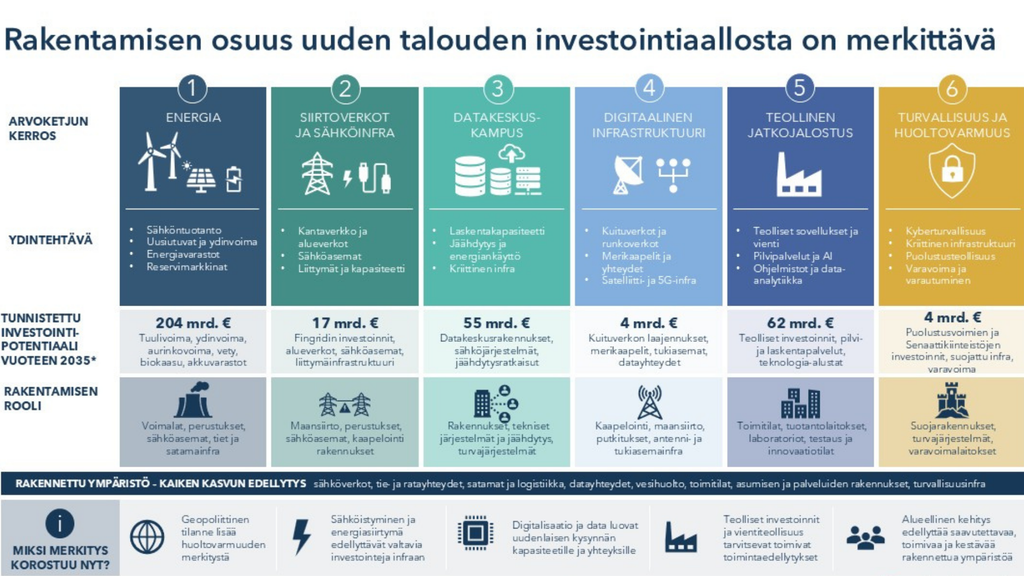
There are a huge number of projects. Investment needs are emerging in energy, networks, data centers and industry, the scale of which is still difficult to grasp. In Finland too, projects related to the new economy have already been identified worth hundreds of billions of euros. Most of them are still in the planning phase, so their position in the global competition has not yet been decided.
For Finland, the question is simple. If Finland does not have space for a data center, an electricity grid around it, sufficiently fast licensing or a stable political outlook, investments will be made elsewhere. The data center is then not just a lost construction project. With it, part of the value creation of the new economy is also lost.
Affordable and clean energy is the beginning. Real value for Finland will only be created when energy, computing, industry and expertise are combined with the global data economy and other megatrends.
We are used to thinking that the new economy and the future are artificial intelligence, data, cloud services and algorithms. In reality, that cloud is built using traditional means. A data center needs a building and land, electricity, cooling and connections. Electricity needs production and networks. Industry needs factories and logistics. And creators need homes and functioning cities. Investment needs a functioning whole around it.
Here, the built environment takes on a new meaning.
Winston Churchill said of the rebuilding of the British Houses of Parliament in 1943: “We shape our built environment, and then it shapes us.”
The statement is appropriate for this time. The built environment is not the backdrop to the economy. It increasingly determines what is possible in the economy. Construction is also a significant part of the investment itself, on average about a quarter.
This is already visible in construction. The cycle has turned, but it is not a return to the old way. Demand for construction is based less on population growth, urbanization, and consumption than before. Apartments and commercial premises are not disappearing. A new layer of growth is now emerging on top of traditional demand, based on energy, data, and also security.
Construction has become accustomed to following economic growth. In the new economy, the situation is partly the opposite: the economic potential increasingly depends on whether we can provide it with the right built environment. The future will not come to Finland ready-made. It will be built this time too. Only a country that is built well will prosper.
See also
More information

Jouni Vihmo
Chief Economist
jouni.vihmo@rt.fi +358 50 520 1636Confederation of Finnish Construction Industries (CFCI)
Write a comment