The most significant environmental, labor and human rights risks in construction materials supply chains often arise at the beginning of the chain, but remain largely invisible with current tools. In this case, companies can unintentionally cause negative impacts on the environment and people. Eleven developers, construction companies and construction material suppliers jointly developed and tested a new control point method in the #KIRAriskDD pilot project. The pilot examined the supply chains of low-carbon cement and steel, as well as gypsum and wood.
Current tools are not enough – a risk-based approach is needed
Current risk management is often based on contractual requirements and individual audits that do not reach critical risk points in the supply chain. In particular, examining only tier 1 suppliers does not reach the points where harmful impacts actually occur. Environmental and human rights risks are particularly associated with mining and green transition minerals, but labor exploitation has also been reported in forestry.
In addition, schedule pressures, lack of information and the complexity of supply chains make comprehensive auditing practically impossible at present, creating a need for a new, targeted and risk-based operating model tailored to the construction sector.
“The builder has a real opportunity to control procurement and influence the conditions under which building materials are produced. Therefore, there is also a responsibility to make informed choices. Taking into account natural and human rights is not just risk management, but a concrete demonstration of the kind of practices we want to promote with our own procurement and how values are reflected in our operations,” says Hemsö Finland’s Building Manager. Kirsi Viheriäranta.
Joint development brings efficiency to supply chain management
In the KIRAriskDD pilot, eleven developers, construction companies and building material suppliers jointly developed a due diligence process methodology in practical supply chains. The joint approach enables consistent data collection practices and increases effectiveness across the industry. In the pilot, four teams focused on cement, steel, gypsum and wood.
Each team included actors from different levels of the supply chain to identify effective roles and responsibilities. The results were validated in joint workshops to ensure cross-learning. The developers involved were A-Kruunu, Hemsö, Elo Mutual Pension Insurance Company and HUS Kiinteistöt. The construction companies included Fira, Skanska, SRV and YIT. The building material suppliers included Peikko, Rudus and Saint Gobain.
Low-carbon materials may introduce new sustainability risks
The pilot selected high-volume building materials and their low-carbon alternatives. Low-carbon transformation changes supply chains and brings with it new raw material flows and thus, at least in theory, new sustainability risks.
For example, the production of low-carbon cement is based on replacing traditional clinker with alternative binders, such as blast furnace slag, fly ash, clay-based materials, and other industrial by-products and recycling-based solutions. These low-carbon enablers are transforming supply chains and introducing new raw material streams, the risks related to their origin, production methods, and sustainability impacts of which need to be identified and understood. Similarly, the use of recycled materials in the supply chains of low-carbon steel introduces new raw material streams, such as industrial or consumer scrap, whose responsible management of origin requires new methods.
“The checkpoint method gave us a new understanding of our supply chains. It was also a pleasure to see that various international suppliers were interested in answering our survey. Overall, the method highlights the importance of cooperation both within our own supply chain and among industry players here in Finland,” says Peikko’s Sustainability Manager. Enni Karikoski.
The KIRAriskDD pilot achieved a good response rate in the international supply chain
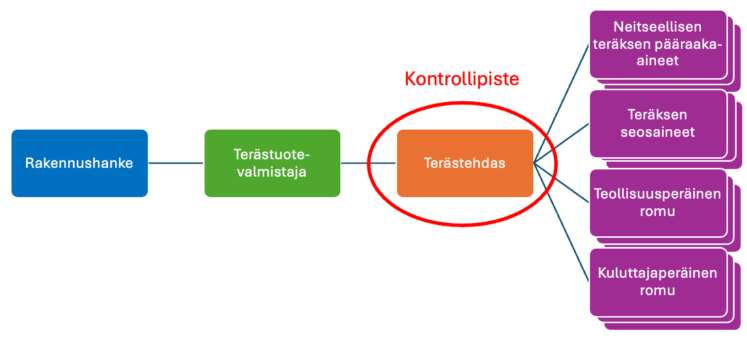
The KIRAriskDD project developed a control point method suitable for the construction sector based on targeting the survey to the upstream actor in the supply chain with the best visibility into the origin of raw materials, such as a steel mill or sawmill. The model is based on an idea presented by the OECD in 2023.
In practice, a questionnaire was sent to each control point company, which mapped the level of sustainability management, supply chain risk management and the situation at the sources of supply chains. For each raw material under investigation, its own specific questions were defined on a risk basis. The questionnaire was sent to several companies operating in different countries in Finland and elsewhere in Europe, as well as one company operating in Asia. The responses were good (8/11). Personal contact proved to be a key means of ensuring response activity.
“The new control point method offers an interesting approach for the construction company, as visibility has traditionally been poor at the beginning of the supply chain. Collaboration with the contractor is valuable in choosing the right control point. Now, when the practices are still taking shape, the willingness to respond is increased by the fact that there are personal relationships with the company defined as the control point in the chain,” says Skanska’s Sustainability Manager. Laura Juselius.
The pilot did not identify any direct negative impacts, but responses highlighted uncertainty about sustainability risks and their management, particularly upstream in the supply chain. In some cases, information was not available or respondents were unable to share it. This reinforces the notion that the greatest risks are often where visibility is lowest.
The goal is a permanent operating model for the entire industry
The conclusion of the KIRAriskDD pilot is twofold. First, the #KIRAriskDD method works in practice: it provides transparency for the project in accordance with the principle of proportionality and a clear way to prioritize further investigations. A single company cannot manage supply chain risks alone. Supply chains are too complex, and influence weakens as the chain progresses. Second, the model does not scale solely through individual construction projects. Scaling would require a multi-stakeholder initiative, as recognized by EU legislation, that would develop the method, reduce duplicate inquiries, and enable a cumulative knowledge base, while taking into account the boundary conditions of competition law. In order to get the multi-stakeholder initiative moving, a sufficient number of industry players must be activated to launch it.
“Managing numerous and long supply chains is challenging on its own. In addition to improving risk-based management of supply chains, developing a common methodology and collaborating will also reduce the workload of suppliers as the number of different inquiries will be reduced and harmonized. As a company, we will do our part to ensure that the development and application of the highly promising cooperation model that has been initiated continues even after the project ends,” commented Rudus’s Director of Sustainability. Terhi Rauhamäki.
The companies that participated in the pilot support the expansion of the method into a permanent multi-stakeholder initiative. The aim is to expand the method to other building materials, such as aluminum, copper, building stones, solar panels and building batteries.
In 2025, the KIRAriskDD research project developed a risk-based due diligence procedure that can be used to manage environmental and human rights risks related to raw materials for construction materials. The project was coordinated by KIRAHub and funded by the TT Foundation. The procedure was piloted in early 2026 together with eleven real estate and construction companies. The Finnish Construction Industry Association RT and Property Owners and Developer Rakli have been involved in the project from the beginning as background parties. The project is also related to the Construction Industry Responsibility Program.
See also
- Expert report on the #KIRARiskDD method
- Petri Suutarinen's blog post: Sustainability risks in the construction sector near and far
- A common control point and questionnaire model can be used to determine the sustainability of the origin of building materials with reasonable effort.
More information
Vesa Ilmarinen, Katalysti Ltd, vesa.ilmarinen@katalysti.fi, 040-5086447
Ville Wartiovaara
Executive Vice President, Regional Director
ville.wartiovaara@rt.fi +358 40 564 7939Talonrakennusteollisuus ry, Uusimaa
Merja Vuoripuro
Director, Communications and Responsibility
merja.vuoripuro@rt.fi +358 40 587 2642Confederation of Finnish Construction Industries (CFCI)