The indoor conditions of public spaces have a major impact on the choice of place of residence, especially for young adults, and thus on the attractiveness of municipalities, according to the results of a study commissioned by the Finnish Association of Building Technology and Industry. Overall, the majority of Finns are satisfied with the indoor conditions of municipally owned spaces – however, a fifth are concerned about them.
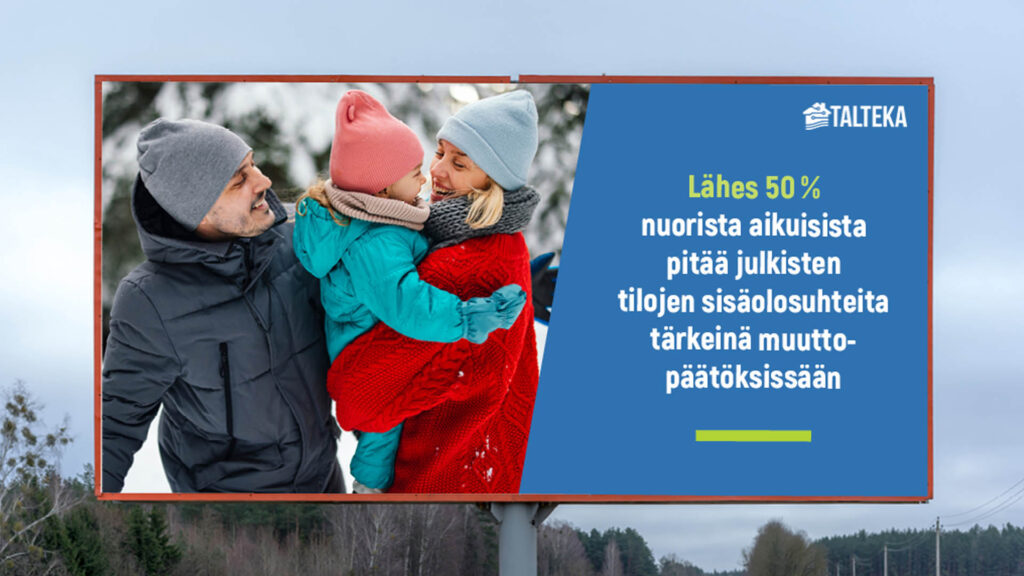
One in three Finns (36 percent) consider the comfort, health and safety of public spaces to be an important factor when considering a change of residence. Good indoor conditions in public spaces are especially important for young adults: almost half of 18–34-year-olds take the condition of public spaces into account when considering a possible move. Indoor conditions consist of the building's indoor air, temperature, lighting, sound environment and clean water.
"Based on the research results, the indoor conditions of municipally managed facilities play a significant role in the attractiveness of municipalities and thereby their vitality. Many municipalities compete especially for young adults. They are often in a life situation where public facilities – daycare centers, schools, educational institutions, libraries, health clinics, sports halls – are used a lot. This probably explains their greater interest in the indoor conditions of public facilities than the rest of the population," says CEO of the Association of Building Technology and Commerce. Ilkka Salo says.
Talteka investigated Finnish attitudes towards indoor conditions in public spaces through a study conducted by IRO Research. One thousand people responded to the study, and the results are representative of the Finnish population nationwide*.
People are quite satisfied with the indoor conditions of their own municipality's facilities
Almost eight in ten Finns (78%) are quite or very satisfied with the indoor conditions of public spaces in their municipality. However, when Finns were asked about the health and safety of public spaces across Finland, 37 percent said they were somewhat concerned and 22 percent were quite or very concerned. A third (35%) were not concerned.
"The health and safety of public spaces clearly concerns and interests Finns. The positive thing is that people are quite satisfied with the indoor environment of their own municipality. Municipalities have done a lot of work to solve indoor air problems, for example, and it seems to have brought results," says Ilkka Salo.
According to data compiled by the Regional Land Management Centre, municipalities, municipal enterprises, joint municipal authorities and municipal companies owned approximately 2020 buildings in 62. Their balance sheet value at that time was over 000 billion euros.
"This is a huge asset that must be managed responsibly. Now that the acute indoor air problems in public spaces have been addressed, the new councils elected in the municipal elections would do well to ensure that the indoor conditions of buildings used by municipal residents and employees are maintained in the long term," Salo states.
“Regular maintenance and upkeep of building systems, and renewal if necessary, is a cost-effective way to prevent indoor air problems, for example, and ensure the sustainable life cycle of buildings. Good indoor air also promotes health. The E3 project's daycare study found that children's morbidity decreased by almost 20 percent when more clean air was produced in the premises.”
In the run-up to the municipal elections, Talteka will also investigate the views of municipal decision-makers regarding the municipalities' building stock and the indoor conditions of public buildings. These results will be published in early March.
* IRO Research conducted the survey online from January 14 to 22.1.2025, 1. The survey sample, N=000, was weighted by age, gender, type of residence, and province to reflect the Finnish population nationwide. The statistical margin of error for the survey is a maximum of approximately 3,2 percentage points.