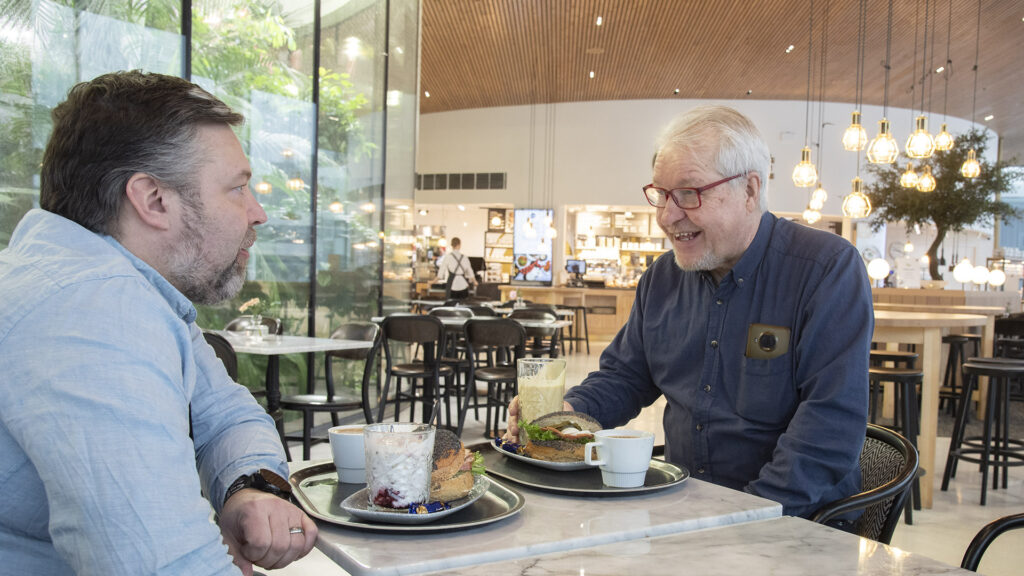
The awakening of occupational safety, the importance of motivation and various indicators were raised on the coffee table when Keijo Päivärinta, a torchbearer of occupational well-being and safety, sat down opposite Henri Litma and has been following changes in occupational safety in our country for over 40 years – and has usually been involved in creating them herself.
“I was such a fool”
“During the recession of the 1990s, construction sites were mostly in terrible condition, especially during the frame phase, work was done without any kind of fall protection. People interested in development work worked on two different construction sites of a large company, and they challenged each other to see which one had the safer and more productive construction site,” Keijo begins by recalling how the first steps were taken in our country towards the systematic development of occupational safety in construction. At the same time, the foundation was laid for future construction industry occupational safety competitions, which began in 1997.
“What were your first steps in construction, how did you end up in the industry?” Henri asks.
"I was such a fool in high school," Keijo replies, laughing with that sound that is so familiar to many.
When he was supposed to start high school at Alppila High School, the young man instead went to work in a construction site. After a few short stints on construction sites, Keijo ended up working at the Hakka construction sites for a couple of years until he began his studies as a construction foreman.
"Haka was my thing, that's where my interest in the field came from and also my awareness of safety in a pretty bad way, when I almost lost my life a couple of times. In Itä-Pasila, I had to clean the deck area, when I was lifting bundles of plywood and fell into an opening that had been exposed underneath," he says. Luckily, Keijo was caught hanging from the opening.
After his studies, Haka invited him again, this time to work as a junior concrete master. There, Keijo learned from surprising places. Matti Räisänen, an occupational safety district inspector known for his quick reports and who carried out his inspections with a tie around his neck and a briefcase in his hand, had made a company-specific inspection report for the Construction Authority of Haka. This had created a thick stack of paper, and by wading through the stories that colorfully described construction site life and were written in his own handwriting, the young concrete master learned a lot about the industry. He soon found himself in Räisänen's colleague's place when a job opening had come up in occupational safety. That was the beginning of Keijo's 1980-year career as a promoter of occupational safety and well-being in the construction industry in 45.
New thinking or criminals in the limelight?
“What are the first things that come to mind when you think about the milestones or changes in construction that have occurred in your career?” Henri asks.
"In the 1990s, the work of the occupational safety district still had a bad reputation among companies. It was a time of change, when people began to understand that occupational safety can achieve good results, better safety and economic benefits when production is uninterrupted and work is planned well," says Keijo.
We were awakened to the understanding that occupational health and safety can achieve good results, better safety and economic benefits.
"The emergence and spread of TR metrics in the industry, safety competitions, they are the biggest and best ways to advance safety, and also the things that everyone knows best."
When the occupational health and safety authorities ordered the TR meter from the Finnish Institute of Occupational Health in the mid-1990s, Keijo was one of the people involved. The meter has since become a popular tool for observing safety on construction sites, although it was not initially intended for that purpose. It has significantly contributed to construction safety over the years, but the early days were not easy.
"In the beginning, there were a lot of people working in occupational safety who thought that the authorities' job was to monitor and catch criminals, not to develop some miraculous measurement methods."
"I wouldn't have started talking about the TR meter, trouble-free production and the importance of planning if the then supervisor of the construction industry division of the Uusimaa occupational safety and health district, Markku Marjamäki, hadn't awakened the entire inspection operation to a new kind of thinking. We started thinking about what was needed to achieve better occupational safety, in addition to simply enforcing the law," Keijo praises his boss at the time.
At that time, projects to develop occupational safety and health supervision were launched, with an emphasis on moving from individual supervision operations to reorienting the entire operation and developing the necessary tools.
“And when a new real-time tool like the TR meter was available to help with directing supervision and advocacy activities, alongside previous accident and sickness absence data, it was absolutely amazing,” Keijo enthuses.
The truth is revealed in companies
In the early years, measurement rounds were only carried out by authorities. It was only later that it was realized that the TR meter is an extremely good tool for companies' own use.
"In supervision activities, the issue now came to light as to how company management can manage safety using the TR indicator tool, and how it functions as a means of arguing about poor working conditions."
When the TR meter's excellence became apparent, the goal was to make the tool available to construction sites. Initially, TR measurements were made on paper by recording the correct and incorrect observations made on the construction site regarding occupational safety in a log book.
"On one rather bad construction site, the measurement form mostly contained incorrect observations. When, after the tour, we sat down at the table with the person in charge and he noticed a huge number of lines from the logger's accounting on the wrong side of the form, the railing carpenter went from there to fix the deficiencies. I thought that the inspector's job would be easy now, since without the measurement results, the repairs would have caused a terrible mess with the construction site," Keijo recalls.
I thought that being an inspector would be easy now.
"While previously company management could explain away safety problems, that was no longer possible. TR made the level of occupational safety at different construction sites transparent. Most large construction companies had considered their own safety level to be good, until the meter revealed the truth. If the TR index was around 30, that was the end of the explanations," Keijo says.
The TR indicator was first used in judging occupational safety competitions in 1997. Today, the index numbers of winning companies in the competition often hover above 95.
To the thorn of the state
"Many people think that TR measurement requires a large construction site with a large number of observations. But TR also works on a small construction site and with a small number of observations. When you see the right and wrong observations and raw data, you can think about the company's risk level and plan improvements."
"Large companies can hire their own surveyors, while SMEs can get the same service from the state, for example by participating in an occupational safety competition and the authorities will take the measurements."
"SMEs have significantly increased their safety levels, and I believe that the fact that occupational safety inspectors visit construction sites to take measurements is behind that," Henri says with gratitude.
“The TR meter then won the European Agency for Safety and Health at Work’s Best Safety Practice Award. That was quite an accolade, what do you remember about that?” Henri asks.
"I wrote the application myself and we emphasized that the measurement method is used as an aid in safety competitions. The whole point of the whole thing was that the tool is made available to the company management, who then starts to manage safety with it, and who then brings about change. Finland's presentation was considered the number one thing there."
A positive spiral started
"In the early 2010s, we developed a monitoring strategy in which companies were divided into two groups. The first group included those that voluntarily promoted safety, for example by participating in occupational safety competitions. These companies did not need to be monitored as much as the second group, which did not pay the same attention to safety," Keijo says.
This caused the number of participants in RT's building industry safety competition to multiply in the early 2010s, which in turn significantly increased the safety level of SMEs during the year. A positive cycle had been created.
"I can take credit for getting structural engineers involved in safety planning. One large construction company was slapped with a ban on use due to the risk of falling. When management received information about the situation that it was a general problem in the company, they started inviting structural engineers to participate in safety work," Keijo says.
Motivation is a good driver
Most of Keijo Päivärinna's 45-year career was spent in construction supervision, holding the titles of construction manager, inspector and chief inspector. More than ten years ago, he began his management team duties at the Regional State Administrative Agency of Southern Finland and his participation in the development of supervision initiated by the authorities. Most recently, Keijo participated in the drafting of the raksa decree.
These days, there are many things that the future retiree still finds exciting, and hopes that those who continue their work will also be excited about. One of them is the importance of motivation in promoting a safety culture.
"Those who have motivation will also do it. The task of the authorities is to create and maintain motivation, to open eyes when measurements are taken and competitions are organized. That's not much else that is needed," Keijo summarizes.
“If a company has a strong desire to develop safety, internal motivation carries much further than external regulatory oversight,” Henri continues.
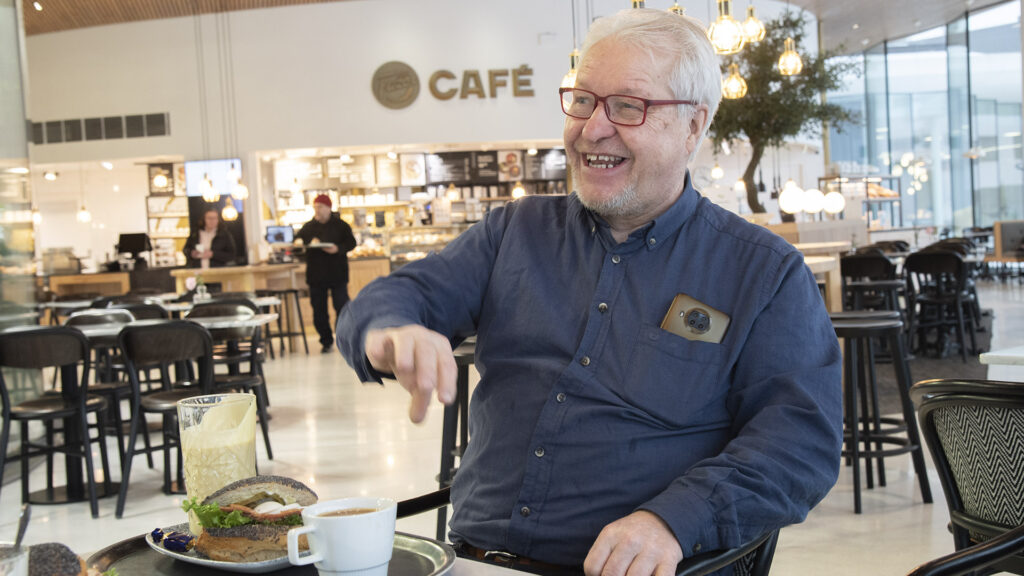
Coffee table discussion participants are enthusiastic about talking about motivation as a tool for safety management.
Coffee table discussion participants are enthusiastic about talking about motivation as a tool for safety management. Neste and Dupont are mentioned as examples of large companies where the importance of the issue has been understood.
"When you receive recognition for your work, it motivates the individual and the organization to act independently towards common goals. Motivation is a better driver than control when it comes to advancing a safety culture," says Henri.
Go to Keijo
Although Keijo managed to do many things in his career, there was one thing he didn't get to do.
“A civil servant is not able to implement changes in practice the way companies and organizations do,” he laments. At the end of the discussion, Keijo Päivärinta states that he is confident that he will leave his work to younger people. And he wants to highlight the names of Henri Litmanen of RT and Ville Lappalainen, Chief Inspector of AVI.
Henri, who himself worked as an occupational safety and health officer for six years, recalls that whenever a new person came to work at the Regional State Administrative Agency, they would tell him to report to Keijo if he didn't know something. In the future, they would report to Ville or Henri.
Coffee table discussions about well-being at work
Henri Litmanen, safety expert at the Finnish Construction Industry Association, invites a group of people to a coffee table with him to discuss occupational well-being and safety in Finland. For the second discussion, Keijo Päivärinta, the retiring chief inspector of the Regional State Administrative Agency of Southern Finland, sat on the other side of the table, whose work as a developer of occupational health and safety for over 40 years is unparalleled.
Who sat at the table?
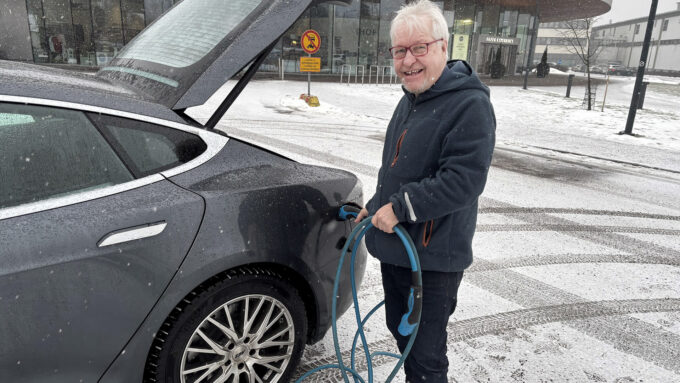
Keijo Päivärinta, Chief Inspector from the Regional State Administrative Agency of Southern Finland, retiring in the spring. Moving from Helsinki to Kotka to spend his retirement years.
With over 40 years of occupational safety work in the construction industry, during which time the occupational safety culture in the industry has changed significantly. A well-known safety influencer in the industry and a colorful speaker at seminars.
Favorite topics include the TR meter, the importance of attitudes and motivations in promoting a safety culture.
If my career were to continue, I would next like to apply the methodology of developmental work research to safety work in construction.
Passionate about languages. Has been studying Spanish for 35 years, now learning Italian.