The annual carbon footprint of the built environment has decreased by 15 percent in four years. The main reason is the rapid carbon reduction of electricity and district heating used to heat buildings. In the future, the energy efficiency renovations of buildings accelerated by the green transition regulation and the construction industry's own climate measures will also cut emissions at an accelerating pace.
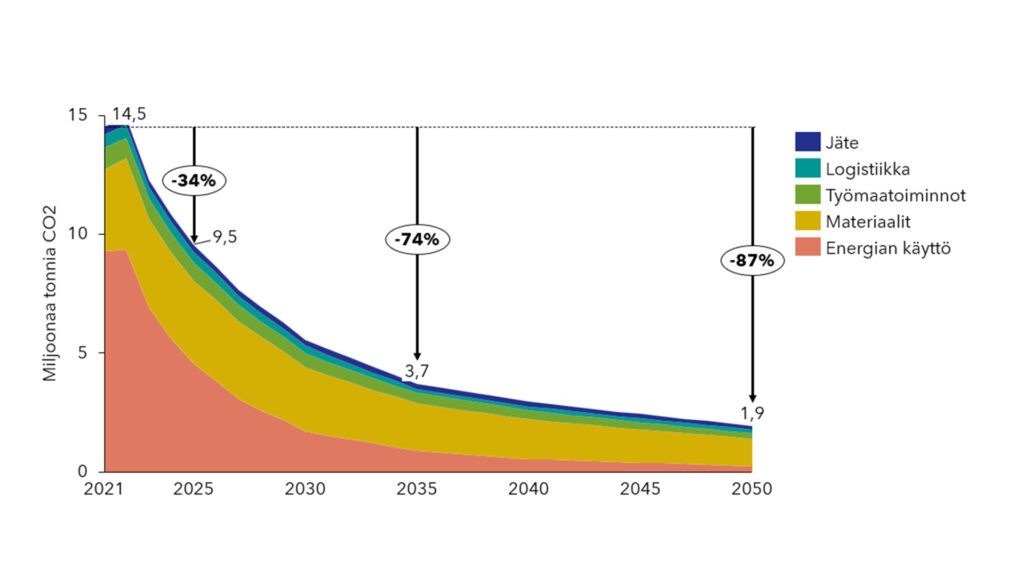
Construction industry RT has updated the Low-carbon construction industry 2035 roadmap, which it prepared for the first time in 2020. The goal of the roadmap is to determine the means to effectively reduce emissions in the built environment and contribute to achieving Finland's carbon neutrality goal by 2035.
The carbon footprint of Finland's built environment decreased by 15 percent as a whole from 2017 to 2021, when it was approximately 14,5 million tons of CO2e. The calculation includes the materials of the construction projects completed in the calculation year and the completed Site activities, as well as the emissions resulting from the use of the existing built environment. The latest available statistical data have been used in the estimate, which in the calculations made now come from the year 2021.
According to the updated carbon footprint calculation, by far the largest source of emissions in the built environment is still the energy consumption of buildings during operation, although its share had decreased to 64 percent. Emissions will decrease even more when we quickly switch to low-emission forms of energy and reduce the energy consumption of buildings.
"In order for Finland to stay on its path to carbon neutrality, the energy efficiency of existing buildings must be improved significantly. The new building energy efficiency directive that has just entered into force strongly pushes for this, but it will not happen by itself, but requires a large additional investment in renovation construction", Rakennusteollisuus RT's director of environment and energy Pekka Vuorinen says.
Repair construction is also important for extending the life cycle of buildings and structures, which is associated with significant emission reduction potential and possible positive effects on biodiversity and costs.
Big bangs for big emissions
The emissions from construction activities had clearly increased in the updated carbon footprint calculation, but the reason for the increase was the increase in the amount of construction. In new construction, emissions are generated from the production of materials, transportation and site operations. The share of building materials in the carbon footprint of the entire built environment was now almost a quarter.
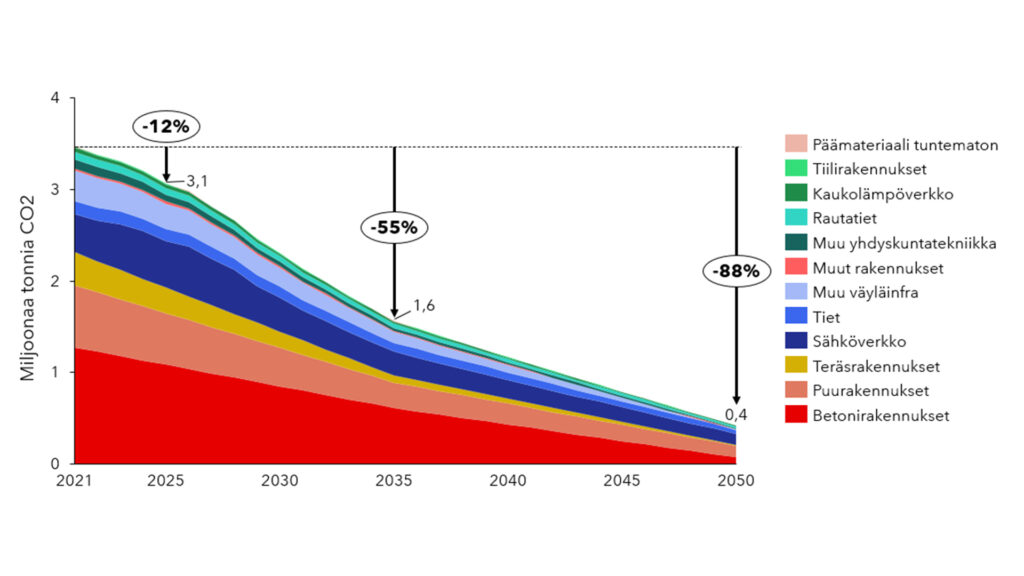
The main drivers of the emission development of building materials are the EU's emissions trading system and industrial innovations. In particular, the technological development of the cement used in concrete and the production of steel will be of great importance in the future. The supply of emission-reducing solutions, such as low-carbon concrete, has clearly increased in recent years.
"Quick actions and big contributions should be focused on the biggest emitters. Since the share of concrete in both house and infrastructure construction is considerable and it cannot be effectively replaced by other materials, it is essential to reduce its emissions. In addition, of course, even small emission reduction measures lead in the right direction and are part of responsibility," states Pekka Vuorinen.
Currently, construction emissions are reduced in practice, for example, by switching to emission-free energy and fuels at construction sites, choosing low-emission or recycled materials, and extending the life cycle of structures. In the construction product industry, for example, green electricity is utilized in energy-intensive production and high-emitting raw materials are replaced with other alternatives.
Emissions from construction are falling
According to the low-carbon road map, emissions from construction activities can be halved from the level of 2021 by 2035 in the so-called basic career, and reduced by up to 89 percent by 2050 in the scenario of innovative solutions. The latter has taken into account the large-scale introduction of technology that captures and stores carbon dioxide in the cement industry and the utilization of the hydrogen reduction method in the steel industry.
The decrease in the carbon footprint of the entire built environment is even steeper in the scenarios when energy consumption during operation is also included. The development is also faster than what was predicted in the 2020 road map, which is largely thanks to the EU-oriented regulation prepared in recent years.
The first Low-carbon construction industry 2035 roadmap was completed in 2020. Rakennusteollisuus RT prepared it together with its stakeholders as part of industry-specific roadmaps commissioned by the Finnish government. In 2024, the road map has been updated in accordance with Prime Minister Orpo's government program. Gaia Consulting Oy has been responsible for the implementation of both roadmaps.
The goal of the low-carbon roadmap update was to refresh the total carbon footprint of the built environment and the scenarios describing its possible future development. At the same time, it was clarified what emission reduction measures have already been taken in the sector and are planned after the previous road map. In addition, the update work carried out an impact assessment of emission reduction measures in terms of costs and biodiversity, among other things, and sub-sector-specific emission reduction paths were examined.
See also
- Low-carbon construction industry 2035 roadmap update (final report)
- Materials of the low-carbon road map
More information
Pekka Vuorinen, director of environment and energy, tel. 050 469 2021
Merja Vuoripuro, director of communications, tel. 040 587 2642
firstname.surname@rt.fi