When talking about industrial construction, it is easy to focus on just prefabrication in a factory or individual technologies. However, industrial construction is a much broader entity. It means developing the entire construction value chain into a planned, predictable and continuously improving production system.
The Industrial Construction Framework, developed at Stanford University's Center for Integrated Facility Engineering (CIFE), helps to visualize the entirety of industrial construction. In the outline presented by Professor Jerker Lessing, industrial construction consists of twelve mutually supporting areas.
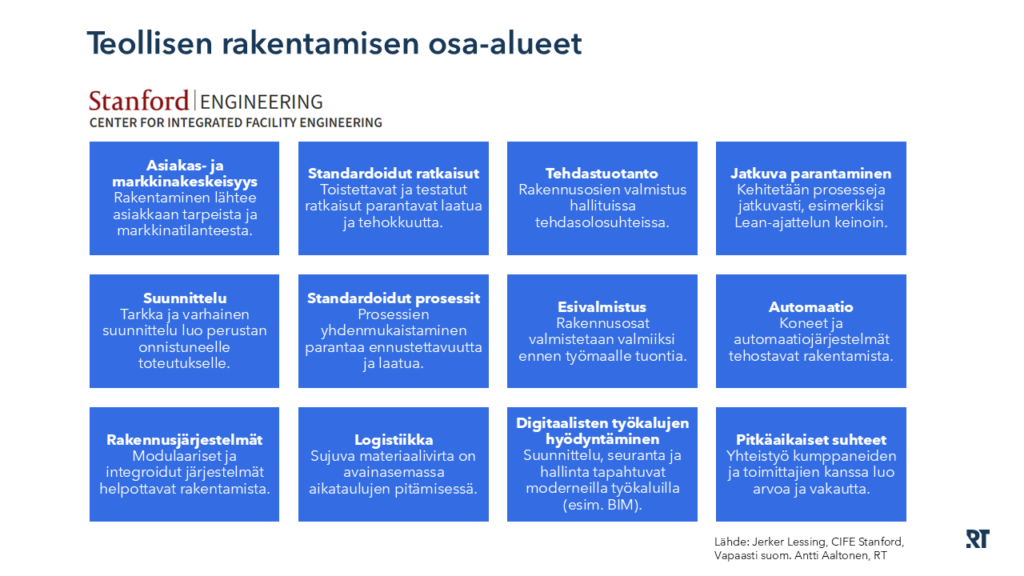
It all starts with customer and market focus. Construction must be based on customer needs and the desired added value, not just the technical implementation of an individual project. Early and accurate planning, in turn, creates the foundation for successful production. When decisions are made in time, changes, waste and problems to be solved on the construction site can be reduced.
The framework also emphasizes standardized solutions, building systems and processes, as well as factory production, prefabrication, managed logistics, automation and digital tools. Long-term partnerships enable joint continuous improvement across the entire supply chain.
It is not a single method or technology, but a way of managing the entire construction system. The underlying idea of CIFE is that the company that makes this whole thing work best will succeed in gaining a significant competitive advantage over others.
Standardization does not mean identical buildings
Standardization in construction sometimes raises suspicions. It is easily thought to mean standard solutions or the duplication of similar buildings.
In industrial construction, however, standardization occurs primarily against the backdrop of the end result. Proven solutions, interfaces, components and operating methods can be reused, even if the end result visible to the customer is still unique.
Every project doesn't have to solve the same problems from scratch. The more we can leverage what we've learned, the more time we have to develop solutions that deliver value to the customer.
Five practical ways to improve productivity
I have applied Stanford's framework to Finnish construction by compiling it into five mutually supporting entities.
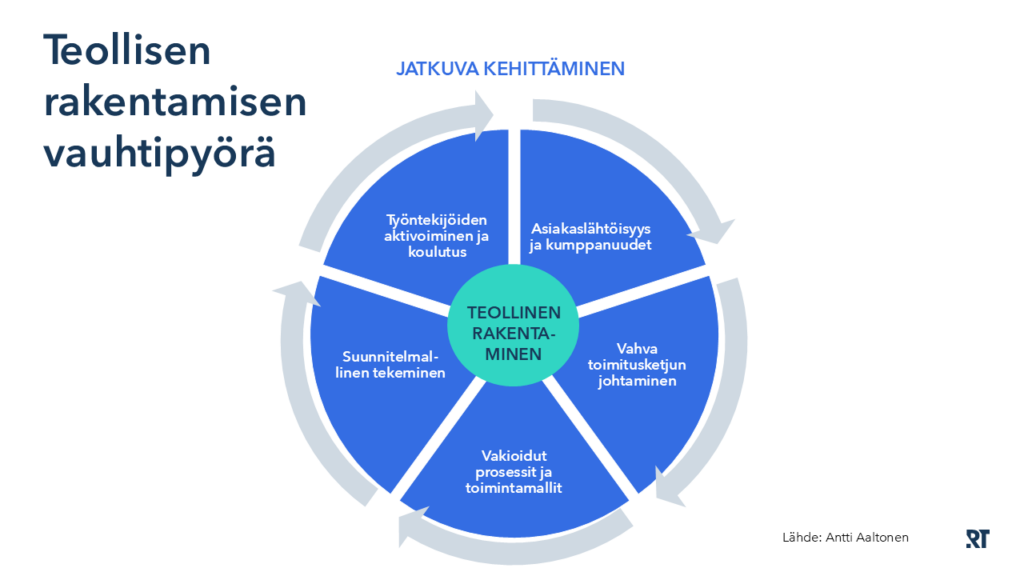
1. Customer focus and partnershipsWhen goals are defined together and key stakeholders are involved early enough, solutions can be developed for the benefit of the entire project, not just from the perspective of one contract or actor. The value created for the customer sets the direction for the entire production system.
2. Strong supply chain management. Design, procurement, manufacturing, logistics and site cannot be optimized in isolation. Productivity comes from the timely movement of products, information and decisions throughout the chain. This requires shared goals, clear responsibilities and close cooperation between different parties.
3. Standardized processes and operating models. Good practice should not be limited to a single project or key person. Repeatable processes improve quality and predictability and create a foundation for developing and scaling operations both within the company and across the industry.
4. Planned action. Construction must be managed as production: everything is carefully planned, the prerequisites for the tasks are ensured, the work phases are coordinated, and deviations are reacted to before they turn into delays or quality problems. The goal is to move from reacting to problems to proactive and controlled production.
5. Employee activation and training. The best information about the smoothness of work and the obstacles of everyday life is often found where the work is done. Employee participation in development and continuous strengthening of competence are therefore at the core of industrial construction. Observations from employees can be used to improve processes, the supply chain and ultimately the value produced for the customer.
These five entities form a constantly evolving circle: from customer needs, we progress through collaboration, common operating models, and systematic implementation to learning – and again to a slightly better way of operating.
Digitalization connects the whole
Digitalization and artificial intelligence support all five areas, but they need interoperable and standardized information as their foundation. True digitalization of the industry will only be achieved when information flows in a common format from design to products, the supply chain, the construction site and further into the use of the building.
This foundation is being built, among others, under the leadership of the Finnish Construction Industry Federation (RT). Digitalization of the built environment in the RYD project, which aims to enable the smooth utilization of information throughout the life cycle of the built environment.
Industrial construction is a way to connect people, processes, technology and the supply chain into a functional whole. When this is achieved, the result is better productivity, more consistent quality, safer work and greater value for the customer.

Antti Aaltonen
Director, Construction Development
antti.aaltonen@rt.fi +358 40 514 3626Confederation of Finnish Construction Industries (CFCI)
Write a comment