The Industrial Accelerator Act (IAA) is giving the Commission a very broad power to adopt delegated acts, which no longer facilitates the free movement of construction products in the internal market, but harmonises the characteristics of construction products instead of a common technical language. This is not at all appropriate.
The IAA applies in practice to numerous EU regulations and includes amendments to, among others, the recently entered into force EU Construction Products Regulation (CPR). The CPR, in turn, already provides the Commission with ample powers to issue both delegated and implementing acts.
The IAA increases the Commission's legislative powers at the expense of the Member States and the Parliament. Based on the IAA, the Commission could, for example, regulate a voluntary low-carbon classification system for construction products or a low-carbon requirement for construction products. In addition, the Commission's legislative powers would be expanded by reducing the framework conditions for the adoption of delegated acts under the Construction Products Regulation.
Harmonization of ready-mixed concrete – a dead-born idea
The Commission has already taken steps, among other things, to harmonise the EN 206 concrete standard. It has justified the need by stating that cement is mentioned in the IAA. Since the final product to be purchased is not cement but concrete, the Commission considers that ready-mixed concrete also needs to be harmonised.
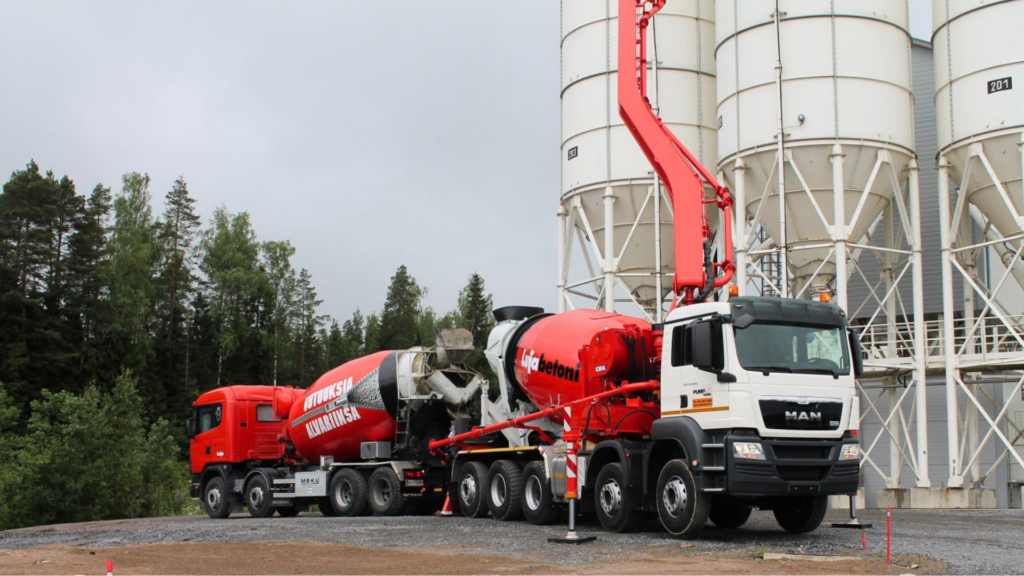
Ready-mixed concrete is not a traditional EU internal market product. Ready-mixed concrete does not move long distances within the internal market, usually no more than about 30 kilometres. It is a fresh product that must be cast within 90 minutes. Therefore, its harmonisation for the sake of the functioning of the internal market is not important.
The Construction Products Regulation was originally intended to be a regulation regulating the free movement of products in the internal market and a means of communicating product characteristics, which is what it should be maintained as. On the other hand, the IAA is intended to counter threats to EU production from outside the EU. For this reason, it should not be used in a way that does not promote the production of EU construction products.
The conditions in different Member States, including climate, vary across Europe. For example, there is frost and snow loads in some places, while there are earthquakes in others. The properties of raw materials, such as aggregates, also differ considerably across Europe. Climate and local stress conditions have a significant impact on the durability and strength development of concrete.
National construction traditions, in turn, guide the design and implementation in each country. There are thousands of pages of national concrete reference documents in use in Europe, making it practically impossible to combine them into a single, uniform standard. Establishing uniform technical requirements without compromising quality and safety would be challenging.
Ready-mixed concrete is a semi-finished product, the safety and quality of which are affected by the operations carried out on site. It is impossible to harmonise the pouring, compaction, post-treatment, site and weather conditions of the concrete.
The threat of concrete's low-carbon classifications collapsing
Harmonization of ready-mixed concrete would slow down the reduction of the carbon footprint. Finland and many other countries already have functioning and widespread national low-carbon classifications for concrete. If harmonization were to be undertaken, it would lead to the abandonment of national classifications and the construction of a new system, which would take several years. This would also cause years of delay in the introduction of new, lower-carbon materials and would force the renewal of existing systems that have been found to be working.
Furthermore, the commonality of EU-level reference levels and emission classifications would be practically impossible, as concrete compositions differ significantly from country to country. Such harmonisation would also conflict with the EU's own climate targets implementation timetables. Digitalisation is not a real problem either, as the European ready-mix concrete industry is developing a standardised, digitalised product information package, which is currently being piloted in Norway.
EN 206 has worked very well for 25 years. The flexibility of the national annexes and application standards in EN 206-1 and EN 206-2+ allows for a common baseline, consideration of local conditions, effective quality assurance and rapid introduction of innovations. Renovating the entire system would require a huge amount of work, a lot of time and increase risks. The IAA must be amended so that this unnecessary and worsening work is not undertaken.
What is IAA and its purpose?
On 4 March 2026, the Commission adopted its proposal for a regulation to boost industry (Industrial Accelerator Act, IAA). According to the Commission, the aim is to increase demand for low-carbon technologies and products made in Europe. With the Industrial Boost Act, the Commission aims to stimulate manufacturing, help companies grow in the EU and create jobs in the Union. It also aims to support the deployment of cleaner future technologies in industry. The act contains targeted low-carbon requirements, which, according to the proposal, should be applied in public procurement and public support schemes. The requirements are targeted at specific strategic sectors, such as in particular the steel, cement, aluminium, automotive and net-zero technology industries.

Kirsi Martinkauppi
Sustainability Director
kirsi.martinkauppi@rt.fi +358 50 582 2464Rakennustuoteollisuus RTT ry
Write a comment