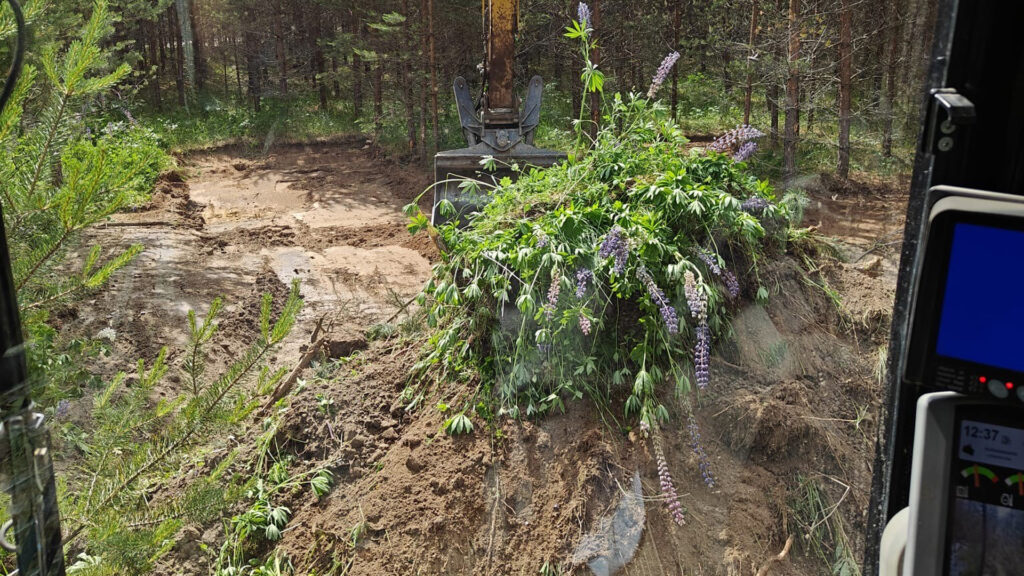
About four thousand tons of lupine. That's how much Rudus destroyed this problematic alien species this year from its gravel collection area in Kirkniemi, Lohja alone. By law, the control of alien species is the responsibility of the landowner – regardless of the size of the land area.
In 2019, lupine and rose were added to the national list of harmful alien species. It means that growing them is prohibited and the growths must be removed. Giant balm had already been banned before.
Handsome Alupine (Lupinus polyphyllus) spreads effectively and displaces original, organic species. Lupine spreads from seeds, which retain their ability to germinate for a long time. In Finland, the first sighting of fugitives on lupine dates back to the end of the 1800th century. Today, it grows almost all over the country, except for the northernmost Lapland.
"Lupines are an ever-worsening problem," states the project manager of the Ketosirkka project Jaana Patrakka From the Uusimaa district of the Finnish Nature Conservation Union.
Patrakka knows what he's talking about, because SLL's Ketosirkka project is managing 54 traditional biotopes and the life cycle of endangered species this summer. In 36 of them, harmful alien species, mainly lupines, are removed.
Departure passes for 4 tons
SLL's Uusimaa district and Rudus have already cooperated in several projects to protect biodiversity. The conservationists of the Ketosirkka project were also involved in removing lupines in Kirkniemi's sand pit.
"A few years ago, you couldn't see lupins at all in Kirkniemi, but this summer they were already growing everywhere," says Rudus' aggregates production manager Aki Mäkelä.
That's when we got down to business.
"During two weeks, we mechanically removed about 6 cubes from the soil mixture, about half of which were lupine. It means that we destroyed about 200 tons of vegetation," Mäkelä recalls.
According to Jaana Patraka, lupine had already spread really badly in the area.
"We focused on weeding out the protective zone between the pit and the forest in order to prevent it from spreading into the field-like environment of the pit. We also removed deposits that had spread to the wooded area," he says.
The hand-picked lupins were packed in sacks and transported to the Rosk'n Roll waste station in Lohja for proper destruction.
"There were about 15 or 50 kilos of lupine in 750 kilo sacks", Mäkelä calculates.
Now we need cooperation
Rudus is constantly fighting lupines at its various locations.
There are many arts. For example, in the summer of 2024, two summer workers did a two-week savota, touring the gravel pits of Hyvinkää, Nummi-Pusula and Lohja Muijala. The work couple cut the flowers of the lupins with a trimmer so that the plant could not set seeds.
Rudus' goal is that nature is more valuable in terms of biodiversity at Rudus' locations when the operation ends than when it begins.
"Lupine is a very harmful alien species for our Rudus LUMO program. Pest control is a huge job and the workload increases every year if nothing is done", Rudus' environmental manager Heli Kanto toteaa.
Kanto calls for cooperation and responsibility in the fight against lupins.
"Decreasing the diversity of nature is a great threat to the earth. Stopping it requires actions from the public, private and third sectors. The best result is achieved through cooperation. There is a need to share information both ways."
This is how you prune lupine
"The most effective way to get rid of the plant is to uproot it. It's best to get started in spring and early summer, when the plant is still small," Jaana Patrakka advises those who want to get rid of lupine.
Lupine can also be mowed before the seeds develop a couple of times during the growing season.
Plant waste is collected in sacks and taken to the waste station for burning. It is essential that lupine seeds should not be left in the wild.
"In the Ketosirkka project "In large outbreaks, we have, as a first aid measure, plucked the seeds from the inflorescences before they ripened and cut off the flower stalks. This way, we can reduce the spread of the plant," Patrakka advises.
Vieraslajit.fiAccording to the website, vigorous species thrive in a growing area enriched by lupine. Meadow plants and the insects that depend on them then have to give way.
Lupine also competes with native plants for pollinators. Its pollen contains a toxic alkaloid, lupanine, which can hinder the reproduction of bumblebees. Lupine is not suitable as food for the larvae or adults of local butterflies. The species has been found to reduce the total number of insects and, in addition to butterflies, especially beetles, dipterans and ants.
More information on handling and destroying invasive alien plants
Text: Leena-Kaisa Simola
Photos: Rudus